Nassau County Property Tax – 🎯 2026 Ultimate Guide to Nassau Property Tax [rates by town, property search, payments, due dates]

Last updated: Month 2026
Data Sources: Town receiver sites, county resources, and published tax information.
Nassau County Property Tax Quick Facts (2026)
- What Nassau property taxes are based on: Nassau County property taxes are determined by your home’s assessed value (based on market value and your municipality’s assessment practices) and the tax levy set by the local taxing jurisdictions.
- Who sends the bill: In Nassau County, property tax bills are typically handled through your town/city Receiver of Taxes (and school/village bills may be separate depending on where you live)
- Typical payment cadence: Many Nassau County property taxes are billed in two installments, with separate schedules for general taxes and school taxes depending on the municipality.
- Where to look up your bill: Use the tools in the Nassau County Property Search section to find your bill, assessment details, and past payments. (Link to the Property Search section.)
- What varies most: Your total bill can change significantly based on your town, school district, any village/special districts, and eligibility for exemptions (including STAR where applicable).
Takeaway: Taxes can differ significantly even between nearby neighborhoods.
Nassau County Tax Rates by Town (quick scan)
| Town / City | What affects totals most | Jump link |
|---|---|---|
| Town of Hempstead | School district taxes + village taxes (if applicable) + exemptions | Hempstead tax payments & due dates |
| Town of North Hempstead | School district taxes + village taxes (if applicable) + exemptions | North Hempstead tax payments & due dates |
| Town of Oyster Bay | School district taxes + village/special districts + exemptions | Oyster Bay tax payments & due dates |
| City of Long Beach | City/general + school schedules + exemptions (where applicable) | Long Beach tax payments & due dates |
| City of Glen Cove | City + county + school schedules (multiple billing windows) | Glen Cove tax payments & due dates |
Nassau County Property Tax Due Dates (at-a-glance)
| Tax type | Due date window | Late fee note |
|---|---|---|
| General tax (most Nassau towns) | Jan 1 – Feb 10 (first half) and Jul 1 – Aug 10 (second half) | Pay within the window to avoid penalties; after the deadline (and once the levy closes), delinquent taxes are handled through the county treasurer. |
| School tax (most Nassau towns) | Oct 1 – Nov 10 (first half) and Apr 1 – May 10 (second half) | Pay by the end of the window to avoid penalty; exact rules can vary by municipality. |
| Long Beach – general & school (city schedule) | General: Jul 1 – Aug 10 and Jan 1 – Feb 10; School: Oct 1 – Nov 10 and Apr 1 – May 10; City: Jul 1 – Jul 31 and Jan 1 – Jan 31 | If you miss the “no penalty” window, fees can apply and payment handling may change once the levy closes. |
| Glen Cove – city/county/school (multiple windows) | City: Dec 1 – Jan 10 and Jun 1 – Jul 10; County: Jan 1 – Feb 10 and Jul 1 – Aug 10; School: Aug 1 – Sept 1 and Feb 1 – Mar 1 | Glen Cove also notes a discount for paying city taxes in full during the first period (Dec 1 – Jan 10). |
Moving to Nassau County?
Property taxes can be a big part of your monthly budget. If you’re relocating to Long Island, Zippboxx can help you plan the logistics—like packing support, coordinating delivery timing, and (when needed) short gaps between closings—so your move feels organized from start to finish.
Are you moving to Long Island or just ready to buy a home ? You have probably given some thought to the cost of living on Long Island and how owning a home will fit into your budget. One of the biggest and most overlooked costs of homeownership is property taxes. With high Nassau County real estate prices and notoriously high tax rates, you can expect a large tax bill. In fact, Nassau County real estate taxes are among the highest in the country!
This complete guide covers everything you need to know about Nassau property tax including taxes by town and how to lower your tax bill.
SEE ALSO:
moving to Nassau County, Long Island movers, storage between closings, local movers on long island, packing services
Nassau County Property Tax Overview
Your Nassau County NY property tax is determined by local taxing jurisdictions including:
- Nassau County
- Your town
- Your village
- Your school district
- Special districts like water districts
Every tax district sets an annual budget. They determine how much revenue they should generate from New York state aid, sales tax, and user fees. This total is subtracted from the annual budget to set a tax levy or how much needs to be raised through property taxes in their jurisdiction. The tax levy is divided by the total assessed value of all real estate in the jurisdiction. This creates your tax rate.
Unlike Suffolk County property taxes , which include school district taxes on the county tax bill, taxes in Nassau County come in the form of separate bills for school districts, Nassau County towns and cities , and village taxes.
How Nassau Property Taxes Are Calculated (Assessment + Levy)
Property taxes are determined by on your home’s assessed value which is based on your home’s market value. Assessors in cities, towns, and villages estimate the market value of property in their jurisdiction then multiply it by the municipality’s level of assessment (LOA) or assessment ratio. Depending on the municipality, your property may be assessed at less than 5% or up to 100% of its market value .
New York uses equalization rates because there is no fixed percentage at which property is assessed, not all municipalities use the same percentage, and some taxing authorities like school districts cross multiple taxing boundaries.
If your municipality has an equalization rate of 100, it means they assess property at 100% of its market value. A rate below that means property is assessed lower than its market value.
Once your Nassau County assessment is determined, the assessor computes your taxable assessed value. This is your assessed value minus property tax exemptions.
Nassau County Department of Assessment
The Department of Assessment develops assessments for all property in the county. The Nassau County assessment roll includes more than 420,000 properties. The department maintains Nassau County land records and the Nassau County tax map. Applications for property tax exemptions and the STAR program are handled by the Department of Assessment.
Nassau Tax Assessor’s Office
- Acting Nassau County Assessor: Matthew R. Cronin, IAO.
- Address: 240 Old Country Rd, Mineola, NY 11501
- Phone: (516) 571-1500
- Hours: Monday to Friday, 8 am to 4:30 pm
What Is the Nassau County Property Tax Rate?
Long Island property tax is among the country’s highest due to high home prices and high tax rates. The New York Comptroller’s Office in 2017 reported an average effective Nassau County property tax rate of 1.88%.
In 2019, the median Nassau County tax bill was $14,872 . By comparison, the median tax bill in Suffolk County was $9,472 and the New York median was $8,081.
Nassau property owners pay more than 4x more in property taxes than the average American.
The 2021 Nassau County property tax rate was 5.15 per $1,000 of full market value plus municipal tax rates for towns and/or villages, school district taxes, and taxes for special districts .
Municipal tax rates range from 0.03 to 18.05 per $1,000 of full market value depending on the town and village. Nassau County school district tax rates range from 10.68 to 42.63 per $1,000 of full market value.
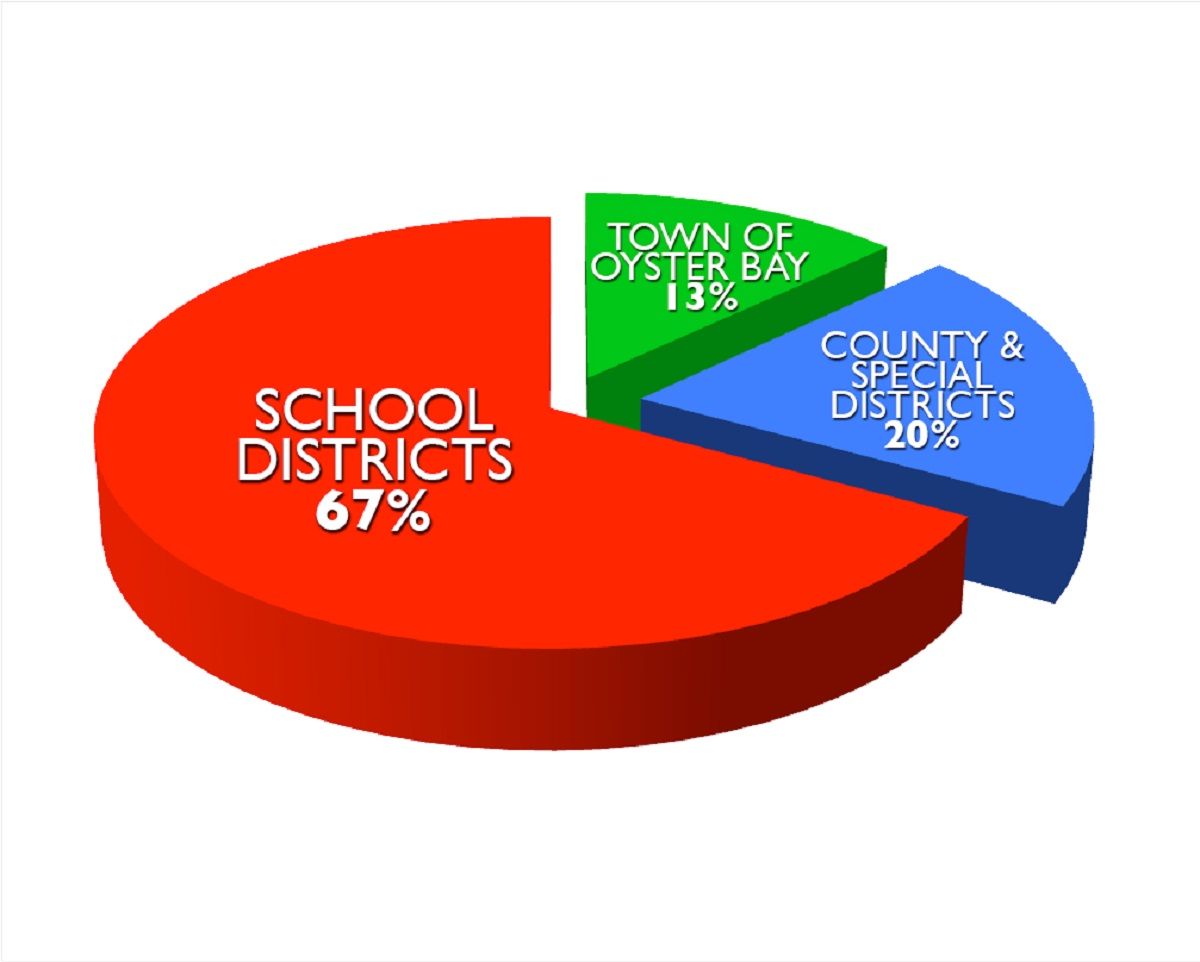
Taxes for Long Island school districts account for the largest share of your total tax bill.
How to Calculate Nassau County Property Tax
To calculate your Nassau County property tax bill, you will need to know your home’s market value, the level of assessment for the municipality or tax authority, and the tax rate.
As a general rule, your full market value is first multiplied by the equalization rate (or uniform percentage of value) to determine a total assessed value. This is multiplied by the tax rate based on the municipality’s level of assessment (LOA). This is done for each taxing authority as some assess taxes based on different assessment ratios. This does not consider tax exemptions.
For example, property in Roslyn Heights in the Town of North Hempstead has a full market value of $717,000. The uniform percentage of value is 0.10. That results in an assessed value of $717. The town and county assess at 100% of this assessed value.
You can then multiply this taxable assessed value by the tax rate for the municipality.
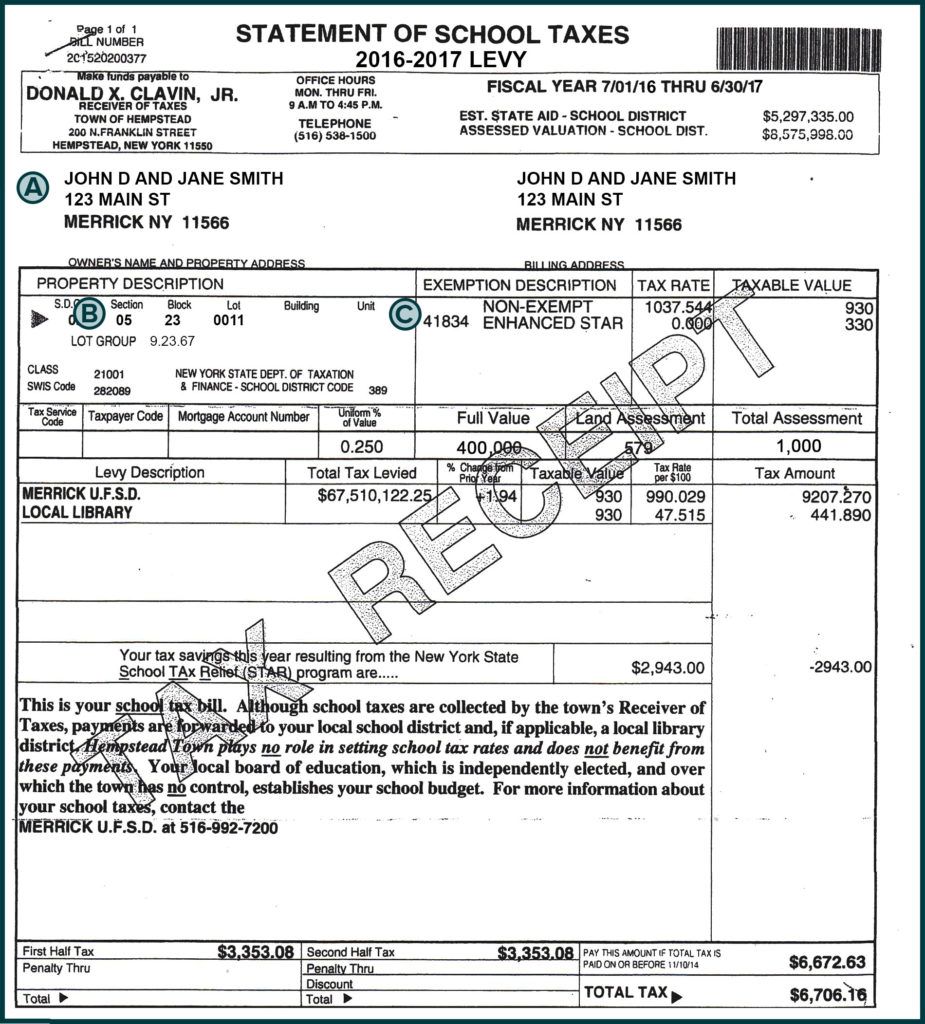
Below is a sample Nassau property tax bill. This example shows a STAR exemption amount – STAR credits are not issued for years in which you receive a STAR exemption to reduce your taxes.
Nassau County Property Taxes by Town
The 2021 Nassau County tax rate was 5.15 per $1,000 of full market value. Most Nassau County property owners also pay a municipal tax rate for their city or town plus school district taxes. Some villages and special tax districts have additional tax levies.
Below are Nassau property taxes in 2021 for municipal taxes and school district taxes in the county. Note that these tax rates are composite rates; check with your city, town, village, and school district for the tax rate for your parcel.
| 2021 Nassau County Municipal Tax Rates | |
| Municipality | Tax Rate (Per $1,000 of Full Value) |
| City of Glen Cove | 7.45 |
| City of Long Beach | 7.21 |
| Town of Hempstead | 2.58 |
| Hempstead villages | 1.85 (East Rockaway) to 18.05 (Hempstead) |
| Town of North Hempstead | 1.49 |
| North Hempstead villages | 0.92 (Plandome Heights) to 7.36 (Lake Success) |
| Town of Oyster Bay | 4.60 |
| Oyster Bay villages | 0.68 (Farmingdale) to 5.32 (Centre Island) |
| Nassau County Property Tax Rates for School Districts (2020) | ||
| Municipality | Equalization Rate | Tax Rate (Per $1,000 of Full Value) |
| City of Glen Cove | 100.0 | 16.69 |
| City of Long Beach | 3.28 | 16.64 |
| Town of Homestead | 0.18 | 9.57 to 42.53 |
| Town of North Hempstead | 0.17 | 14.0 to 37.14 |
| Town of Oyster Bay | 0.17 | 10.68 to 33.89 |
Here are sample school district tax rates for the Town of Hempstead :
- Westbury: 9.57
- Uniondale: 11.60
- Freeport: 16.33
- Hempstead: 18.31
- Merrick : 33.42
- Hewlett-Woodmere: 33.97
- North Bellmore: 34.31
- Levittown: 42.53
Sample school district tax rates for the Town of North Hempstead:
- Great Neck: 14.0
- Manhasset: 14.21
- Roslyn: 20.40
- Herricks: 29.77
- East Willston: 29.78
- Jericho: 37.14
Sample school district tax rates for the Town of Oyster Bay :
You can see 2022 Nassau County assessment rolls here with current tax rates, equalization rates, and assessment levels.
How to Pay Nassau Property Taxes (Online + Mail + In Person) – Nassau County Property Tax Due Dates & Payments by Town
Property taxes are collected by the Receiver of Taxes in each town. Below is information on how to make your Nassau County tax payments, due dates, and important links .
Note that general property tax and school tax can only be paid through the town Receiver of Taxes until the levy closes, typically two weeks after the deadline to pay without penalty. After that, you must pay delinquent property taxes at the Nassau County Treasurer’s Office.
Village property taxes are usually collected separated by each village.
Long Beach Property Taxes
- Long Beach, NY Treasurer
- Online portal to make Long Beach, NY property tax payments
Long Beach, Nassau County property tax due dates:
- First half city tax: July 1 through July 31
- Second half general tax: July 1 through August 10
- First half school tax: Oct. 1 through Nov. 10
- Second half city tax: Jan. 1 through Jan. 31
- First half general tax: Jan. 1 through February 10
- Second half school tax: Apr. 1 through May 10
Hempstead Property Taxes
- Town of Hempstead Receiver of Taxes
- Online portal to make Town of Hempstead tax payments
Town of Hempstead, NY property tax due dates:
- First half school tax: Oct. 1 through Nov. 10
- First half general tax: Jan. 1 through Feb. 10
- Second half school tax: Apr. 1 through May 10
- Second half general tax: July 1 through Aug. 10
Glen Cove Property Taxes
- Glen Cove Controller
- Glen Cove property tax portal to make payments online
Glen Cove, NY property tax due dates:
- First half city tax: Dec. 1 through Jan. 10
- First half county tax: Jan. 1 through Feb.10
- Second half school tax: Feb.1 through March 1
- Second half city tax: June 1 through July 10
- Second half county tax: July 1 through Aug. 10
- First half school tax: Aug. 1 through Sept. 1
There is a discount on city taxes paid in full during the first time period (December 1 through January 10).
North Hempstead Property Taxes
- Town of North Hempstead Receiver of Taxes
- Online portal to make North Hempstead tax payments
North Hempstead, NY property tax due dates:
- First half school tax: Oct. 1 through Nov. 10
- First half general tax: Jan. 1 through Feb. 10
- Second half school tax: Apr. 1 through May 10
- Second half general tax: July 1 through Aug. 10
Oyster Bay Property Taxes
- Town of Oyster Bay Receiver of Taxes
- Online portal to make Oyster Bay, NY tax payments
Oyster Bay property tax due dates:
- First half general tax: Jan. 1 through Feb. 10
- Second half general tax: July 1 through Aug. 10
- First half school tax: Oct. 1 through Nov. 10
- Second half school tax: Apr. 1 through May 10
Look Up Your Nassau County Property Tax Bill
Need a copy of your property tax bill? Want to review your Nassau County assessment or current tax rates? You can do it all easily online.
Use the Nassau County Land Record viewer gives you access to information maintained by the Department of Assessment. Search by property address or section, block, and lot (SBL) to see Nassau County NY property records and important information:
- Nassau County tax map to identify tax district boundaries
- Current and historic tax rates
- Past tax payments
- Assessment roll information
- Property photographs
- Tax exemptions and amounts
- Comparable home sales
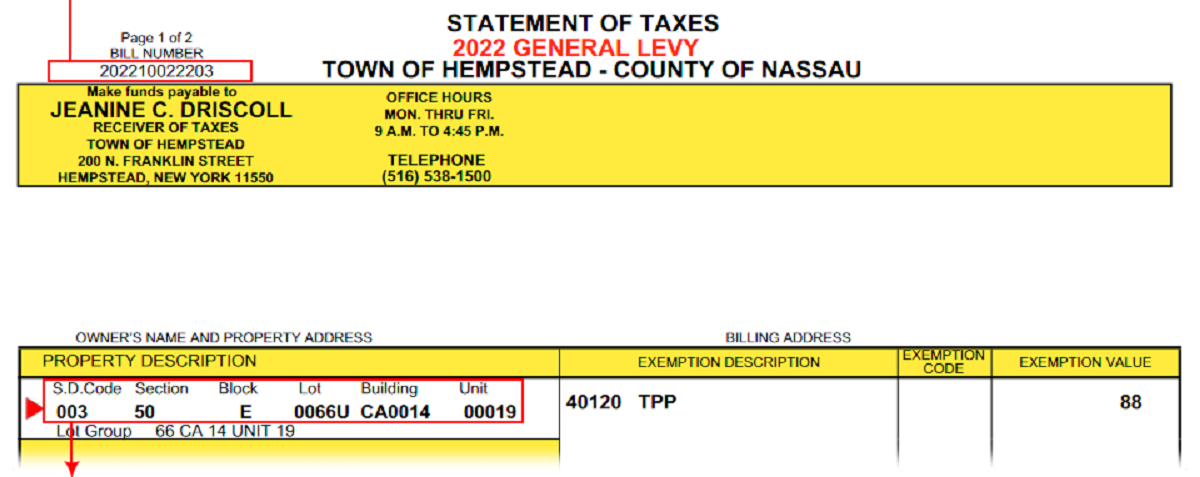
You can also use this MyNassauProperty tool. Use My Nassau County property lookup to see your fire district, school district, police precinct, road management officials, and elected officials.
If you need a Nassau County property tax lookup, use the tool provided by your town Receiver of Taxes. Each town offers a Nassau County tax lookup portal that lets you pay your taxes online and see past tax payments, current taxes due, assessment information, and more.
Nassau County property tax lookup by town:
How to File a Property Tax Grievance in Nassau County –Appealing Your Nassau Property Assessment
Your property is assessed every year. If you do not agree with your assessed value, you have the right to appeal. You must appeal your assessment before your property taxes based on the new assessment are billed. For 2022, appeals were accepted between January 3 and March 1, 2022.
You can file a request for the Assessment Review Commission (ARC) to review your assessment online. Click here to file an appeal or check the status of an appeal before the Nassau County tax grievance deadline.
Property Tax Exemptions – New York STAR Exemption & More
Applying for tax exemptions can reduce your real estate taxes significantly by making a percentage of your assessment exempt from taxes.
Here’s an overview of exemptions that can reduce property tax in Nassau County. Note that property tax exemption applications for 2023/2024 must be submitted by January 2, 2023 .
STAR Program
When you buy a home, you must register with the NY Department of Taxation and Finance to qualify for the STAR Program. Eligible owners receive a check from NYS rather than a direct school tax exemption. You are eligible for the Basic STAR program if your primary residence does not exceed $500,000. The Enhanced STAR program is offered to seniors who meet income guidelines.
Veterans Exemptions
Certain veterans are entitled to an exemption on county and town property taxes along with school taxes for districts that have chosen to offer a reduction.
Senior Citizens’ Exemption
Seniors who meet income guidelines are entitled to an exemption of 5% to 50% on Nassau County, town, and school taxes. Special district taxes are not reduced.
Limited Income and Disabilities Exemption
Homeowners with a mental or physical impairment that makes them substantially unable to engage in major activities of life can qualify for an exemption of up to 50% of their assessment.
Volunteer Firefighters & Ambulance Workers
With at least five years of service, ambulance workers and volunteer firefighters can qualify for an exemption of 10% of their home’s assessed value.
Nassau Property Tax FAQ
Why are Nassau County property taxes so high?
Nassau County property taxes are driven by a mix of local budgets (tax levies), high property values, and the large share of the total bill that often comes from school district taxes. Your total can also change based on whether you’re in a village or special district, and what exemptions you qualify for.
How do I look up my Nassau County property tax bill?
Start with the Nassau County Property Search tools in this guide to find assessment and tax details by address or section/block/lot (SBL). If you want the actual payment portal and bill history, use your town Receiver of Taxes online lookup (linked in the Property Search section).
When are Nassau County property taxes due?
In many Nassau County municipalities, general taxes are typically due in two halves (often around Feb 10 and Aug 10) and school taxes are also billed in two installments with windows that vary by municipality. Always confirm your exact schedule using your town/city Receiver of Taxes because due dates can differ by location.
How do I pay my Nassau County property tax bill?
You typically pay Nassau County property taxes through your town (or city) Receiver of Taxes until the tax levy closes. After that point, delinquent property taxes are generally handled through the Nassau County Treasurer’s Office. Most towns offer online payment options, as well as mail and in-person payments.
Can I lower my Nassau property taxes?
If you believe your home is over-assessed, you can file a property tax grievance (assessment appeal) within the county’s grievance window for that year. The basic process is: review your assessed value, compare it to similar properties, submit your grievance through the county’s process, and track the status.
What exemptions exist in Nassau County / New York (STAR, etc.)?
Some homeowners may qualify for exemptions that reduce taxable value, including STAR (where applicable) and other exemptions such as veterans, senior, disability/limited income, and certain volunteer first responder programs. Eligibility and deadlines vary, so the fastest way to confirm is through the county assessment resources and your municipality’s exemption guidance.
Now that you know everything there is to know about Nassau County, Long Island property tax, are you ready to take the plunge into buying a home? Once you’ve started the process and you have a closing date on the horizon, give us a call at Zippboxx to get started with a free, personalized moving estimate. We can have you quickly settled into your new home without the stress and long days of unpacking so you can enjoy everything Long Island living has to offer.
SHARE THIS POST:

Zippboxx
On-Demand Storage Experts
Zippboxx is much more than a team of people who love to keep you moving. We’re deeply invested in our people and our community.
Leave A Comment
Contact Zippboxx for Moving & Logistics
Blog - Website Form
Recent Posts






Services We Offer